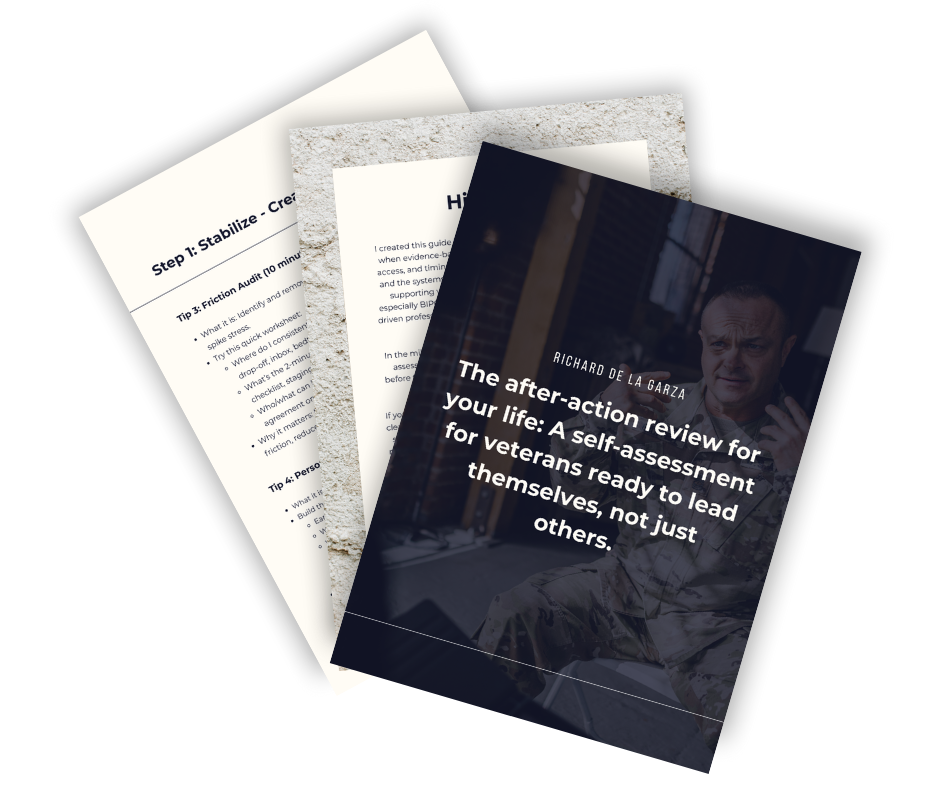
What veteran career counseling should actually address
Most veteran career counseling starts and ends with the practical mechanics: translating military experience into civilian resume language, practicing interview answers, learning how to talk about leadership without using rank. That work matters. It is also incomplete, and I have watched too many veterans get the resume right and still struggle six months into a new job for reasons no career counselor addressed.
In case you are new here, I am Richard De La Garza, offering therapy for veterans and helping veterans and military connected individuals navigate the transition from survival to leadership with dialogue centered, trauma informed care. Career questions often bring people to me first, and the deeper clinical work usually reveals itself once we start looking at why the job search alone has not been enough.
I offer something different because I come at this from two directions. I am a veteran who went through this exact transition, and I am a licensed clinical social worker, trained at Columbia University, who understands why the mechanics alone are not enough.
Why standard career counseling often falls short for veterans
Free career counseling exists through the VA and through several excellent veteran service organizations, and I refer clients to those resources regularly. What they are built for is the practical transition: translating your MOS into language a civilian hiring manager understands, building a resume, and preparing for interviews.
The mechanics get solved, but the identity question does not
What often goes unaddressed is the deeper identity work. A veteran can walk into a new job with a perfectly translated resume and still feel like an impostor in a room full of people who never had to prove themselves under fire. That feeling does not show up on a resume, and it rarely gets addressed in a standard career workshop.
Why timing matters more than most veterans expect
A lot of veterans start their career search the moment their service ends, treating the transition like a task to complete as quickly as possible. That urgency is understandable, but rushing the search often means skipping the identity and adjustment work entirely, which tends to surface later anyway, usually at a less convenient moment, like three months into a new job when the adrenaline of the transition has worn off.
Authority does not transfer automatically
In the military, authority came with rank. In a civilian workplace, authority has to be earned through relationships and results, and that shift catches a lot of veterans off guard. Career counseling that only covers job search mechanics leaves veterans unprepared for this specific frustration, which shows up in the first ninety days of a new role far more often than in the interview itself.
The frustration of watching decisions get made slowly
Military decision cycles, especially under real time pressure, move fast and clearly. Civilian organizations often move slower, with more competing opinions and less clarity about who actually owns a decision. Veterans frequently describe this slower pace as maddening, and standard career counseling rarely warns them that this frustration is coming, let alone gives them tools to manage it without becoming the person in the office everyone considers difficult.
What a therapeutic approach to career counseling adds
My work goes beyond helping a veteran get hired. It helps them understand why certain workplace dynamics feel destabilizing and gives them tools to navigate those dynamics without falling back into old survival patterns.
Naming the hypervigilance that follows you to the office
Many veterans carry a state of constant readiness into civilian workplaces without realizing it. That hypervigilance can look like over-monitoring coworkers, distrusting leadership before they have earned distrust, or feeling exhausted at the end of an ordinary workday for reasons that are hard to explain. Career counseling that ignores this leaves veterans managing symptoms they do not have language for. This is where a Freirean approach matters: we name what your nervous system is actually doing before we try to talk you out of it.
Building a career plan around actual values, not just available openings
A lot of veterans take the first job that will have them, because the transition period feels urgent and unstable. I slow that process down enough to ask what this person actually wants their working life to look like, not just what job posting matched their military occupational specialty.
Preparing for the loneliness of civilian teams
Military units create a kind of forced cohesion that civilian workplaces rarely replicate. Veterans often describe a quiet loneliness in their first civilian job, even when the job itself is going well. I prepare clients for that loneliness directly instead of letting it surprise them, and part of that preparation includes pointing clients toward peer connection outside of work, like veteran support groups, so the workplace is not the only place they are expected to find that sense of belonging.
Working through the guilt of leaving service behind
Some veterans carry a quiet guilt about building a comfortable civilian career, as though moving forward somehow betrays the people they served alongside. That guilt can quietly sabotage a career transition, showing up as self-sabotage around promotions, raises, or simply allowing themselves to enjoy a new role. Naming this directly, rather than letting it operate in the background, is part of the work I do that a standard career counselor is not trained to address.
What a session actually looks like
Career counseling with me does not look like a checklist session. It looks like a conversation that moves between practical planning and the deeper adjustment work underneath it.
We start with where you actually are, not a generic intake form
I ask direct questions about what has already gone wrong in previous job searches or previous jobs, not just what your resume says. Most of the useful information comes from the specifics of what has not worked yet.
We build a plan you can actually follow, not just a strategy on paper
Following my own core value of consistency over intensity, I help clients build small, repeatable habits around their job search and their early days in a new role, rather than a single dramatic plan that is hard to sustain past week one.
We revisit the plan as the transition unfolds
Career transitions do not follow a straight line. I check in on how the plan is actually holding up once someone is in a new role, not just during the job search itself, because the hardest part of a transition often happens after the offer letter, not before it.
We build language for the questions civilians actually ask
Civilian coworkers and interviewers ask questions veterans are not always prepared for, questions about hobbies, about work-life balance, about what a normal Tuesday looks like, that can feel oddly disorienting after years of military structure. Part of what I work on with clients is building comfortable, honest language for these ordinary conversations, since fluency in small talk is its own kind of civilian skill that rarely gets addressed directly.
How this connects to the deeper transition work
Career is rarely the only thing shifting during this period of someone's life. Identity, relationships, and a sense of purpose are usually shifting at the same time, which is why career counseling works best when it is connected to the broader military transition counseling I offer, rather than treated as a separate, isolated service.
When career counseling alone is not enough
If someone is dealing with more significant trauma symptoms alongside the career transition, I address that directly rather than staying narrowly focused on job search logistics, because a career plan built on top of unaddressed trauma tends to collapse under pressure.
Why I keep career and clinical work under one roof
Many veterans end up seeing a career coach for the job search and a separate therapist for everything underneath it, with neither professional fully understanding the other half of the picture. I keep both under one roof deliberately, because the career questions and the deeper adjustment questions are almost never actually separate, no matter how cleanly they get divided on paper.
What progress actually looks like in this work
Fewer job applications sent out of panic
Early in the process, clients often apply to anything remotely relevant out of anxiety about the gap on a resume. As the work progresses, applications become more selective and more aligned with what the person actually wants, which tends to produce better interviews and better offers than a scattershot approach ever does.
Walking into a new role without needing to prove anything on day one
A veteran who has done this work tends to walk into a new job with a settled sense of their own value, rather than needing every interaction in the first month to prove they belong there. That settled confidence is one of the clearest markers that the deeper work, not just the resume, actually landed.
Ready to build a career that finally feels like yours
If you are a veteran staring down a career transition and the mechanics of resume writing feel like they are missing something important, that instinct is worth trusting. Job search advice alone rarely addresses what actually makes this period difficult.
I help veterans build career plans that account for the whole picture, drawing on my own transition out of service and my clinical training in trauma-informed, leadership-centered care. Whether you need military transition counseling focused specifically on career, or a broader look at what this chapter of life requires, the plan is built around you, not a generic template. This work moves at the pace of your actual transition, not a fixed number of sessions borrowed from a program designed for someone else's timeline.
I work with veterans in and around San Diego, Los Angeles, and San Marcos, and virtually as well. Book your consultation today.
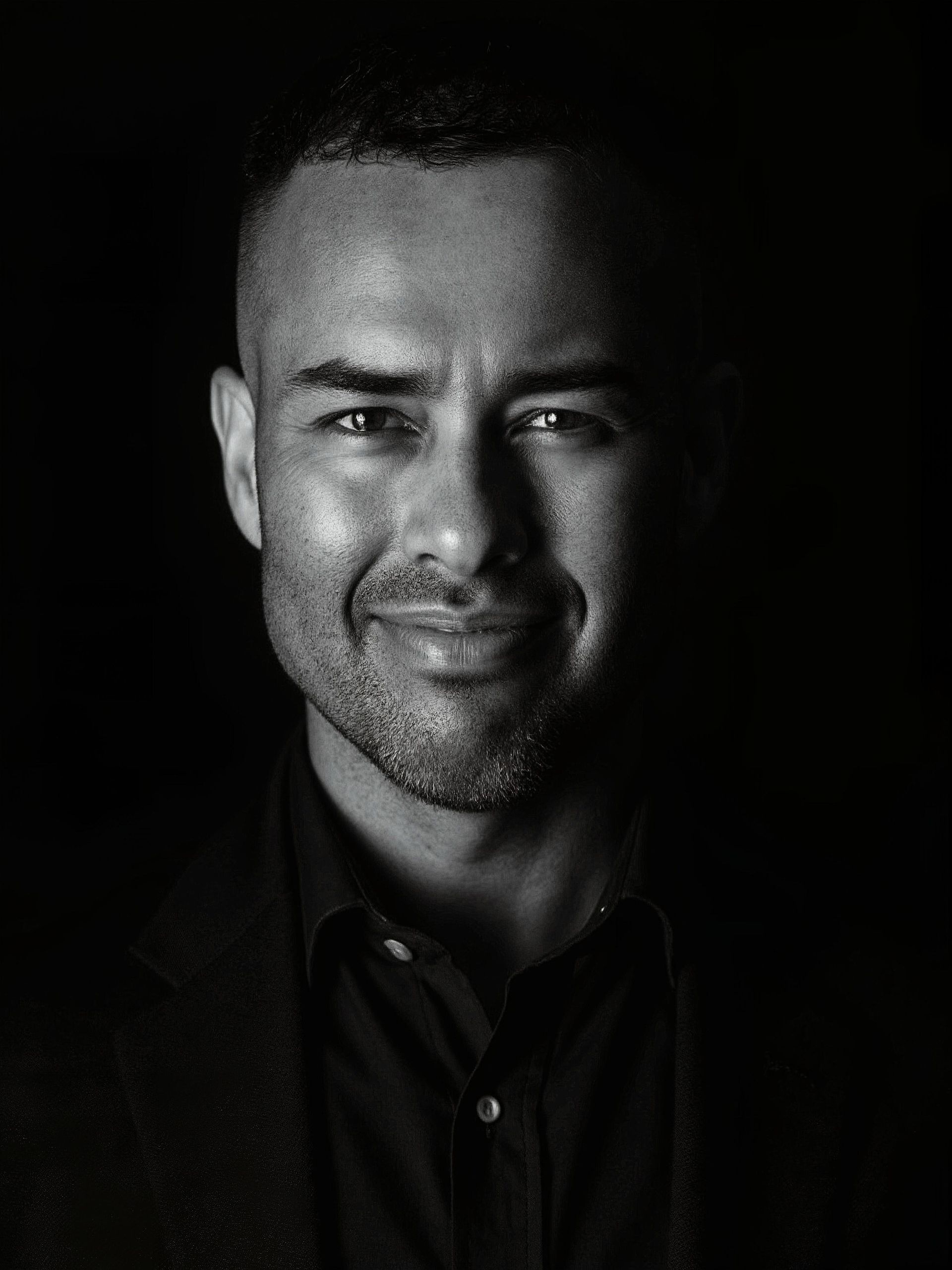
Hi, I’m Dr. Richard de la Garza
I specialize in liberation-rooted support for veterans, military-connected individuals and families, with a particular commitment to BIPOC and LGBTQ communities.