Military Life Family Counseling | Strengthen Relationships & Navigate Transitions
If you are navigating stress, disconnection, or tension within your family, you are not alone, even if it feels difficult to name. You may notice changes in communication, increased conflict, shifting roles, or a sense that something feels off at home but hard to fully explain.
If you are new here, I am Richard De La Garza, LCSW, a therapist who works with military-connected individuals and families seeking support that extends beyond the therapy room. If you are looking for guidance around family dynamics, transitions, or the impact of military life on your relationships, you are in the right place.
Military life family counseling offers a grounded and respectful space to understand what is happening within your family system, including how stress, service, and ongoing demands shape the way you relate to each other. Together, we explore common challenges, practical approaches, and clear ways to create more stability, communication, and alignment at home so your family can function in a way that feels more steady and sustainable over time.
What is military life family counseling?
Military life family counseling is a structured and supportive form of therapy that helps families navigate the unique demands of military life. It focuses on how service-related stress, frequent transitions, separations, and shifting roles impact the way family members relate to each other.
Rather than viewing challenges in isolation, this work looks at the family as a system. Changes in routine, reintegration after deployment, or ongoing operational stress can influence communication, parenting, emotional availability, and overall stability at home.
This type of counseling matters because many family difficulties are not simply about “behavior” or “conflict,” but are shaped by accumulated pressure, uncertainty, and adaptation over time. Without a clear way to understand these patterns, families may feel stuck, reactive, or misaligned.
Military life family counseling creates a grounded space to make sense of what is happening and to translate that understanding into practical changes. The goal is to support clearer communication, more stable family dynamics, and a way of functioning together that feels more consistent, supportive, and sustainable in everyday life.
Most common challenges in military-connected families
- Breakdowns in communication. Conversations may feel tense, reactive, or unproductive, making it harder to understand each other clearly.
- Changes in roles and responsibilities. Shifts related to deployment, reintegration, or work demands can create confusion or imbalance in how the family functions.
- Increased conflict or tension at home. Small issues may escalate quickly, or there may be a constant underlying sense of friction within the household.
- Emotional distance within the family. Family members may feel less connected, less present, or unsure how to relate to each other as things change.
- Difficulty adjusting to transitions. Frequent moves, separations, or lifestyle changes can make it harder to establish consistency and stability.
How do I know if military life family counseling could help us?
- Do things feel more tense or unstable at home than they used to? If the household feels harder to manage or less steady, counseling can help identify what is driving that shift.
- Are changes in routine or roles affecting how we function as a family? Transitions related to military life can create imbalance. Support can help restore clarity and structure.
- Do small situations turn into bigger issues more quickly than expected? If reactions feel stronger or harder to manage, it may point to underlying stress that needs attention.
- Are we handling day-to-day responsibilities but still feel out of sync? Even when everything is getting done, a lack of alignment can signal deeper dynamics worth addressing.
- Are we avoiding certain conversations or situations at home? Avoidance can build over time. Counseling provides a way to approach these topics in a more structured way.
- Do external pressures seem to be affecting how we relate to each other? Stress from work, service, or ongoing demands often shows up in family interactions, even if indirectly.
Ready to get started?
Step 1: Grounded Intake & Shared Mapping
We start with a collaborative intake session where we slow down together, map what’s happening in your body and life, and name the systems, histories, and power dynamics that have shaped how you respond. This isn’t a checkbox assessment, it’s a Freirean dialogue where your story is treated as real knowledge, not a problem to be fixed.
Step 2: Freirean Praxis Sessions (Reflection + Action)
In ongoing 1:1 sessions, we practice praxis: we reflect critically on your patterns, triggers, and environments, and then translate that insight into small, concrete actions that honor your values and your nervous system. You’ll leave each session with 1–3 grounded experiments or practices, no perfectionism, no overwhelm, just doable steps toward more dignity, choice, and ease.
Step 3: Integration, Reclaiming, and Future Alignment
As we work, we regularly pause to reflect on what’s shifting: how you’re feeling in your body, how your relationships and boundaries are changing, and what freedom looks like for you now. Together, we refine your practices, celebrate what’s working, and craft a sustainable way of living and leading that’s aligned with your values, so the transformation isn’t just a session experience, but part of your everyday life.
Hello, I am Richard De La Garza, LCSW.

I work with veterans and military-connected families who are navigating stress, transitions, and changes in how they function together that can feel difficult to understand or manage. Our work focuses on making sense of how service, ongoing demands, identity shifts, and accumulated pressure shape family dynamics, including roles, routines, and day-to-day interactions.
Together, we create enough clarity and stability so your family is not operating in constant reactivity or imbalance, but instead moves with more structure, coordination, and a way of functioning that feels sustainable in real life.
What topics can we work on in military life family counseling?
- Family structure and daily functioning. We look at how routines, expectations, and day-to-day systems are working, and where adjustments can create more stability at home.
- Parenting under stress. We address how pressure, fatigue, and external demands impact parenting approaches and consistency.
- Transitions and reintegration. We work through adjustments related to deployment, relocation, or returning to civilian or family life.
- Boundaries with external demands. We explore how work, service obligations, and extended family influence your household and how to set clearer limits.
- Coordination and shared responsibilities. We clarify how tasks are managed and how to reduce friction around responsibilities.
- Supporting children through change. We focus on how children are responding to shifts in the environment and how to better support their adjustment.
Tips and resources for supporting your family
- Protect time for coordination. Setting aside brief, regular check-ins helps keep expectations aligned and reduces last-minute tension.
- Adjust expectations during high-demand periods. Recognizing when the family is under increased pressure allows for more flexibility and fewer unnecessary conflicts.
- Support individual regulation within the household. When each person has space to reset and manage stress, the overall family dynamic tends to stabilize.
- Be intentional about external input. Limiting exposure to unrealistic standards about family life can reduce pressure and allow you to focus on what works for your specific situation.

Hi, I’m Dr. Richard De La Garza, a Mexican American–Chicano Licensed Clinical Social Worker
I specialize in liberation-rooted support for veterans, military-connected individuals and families, with a particular commitment to BIPOC and LGBTQ communities.
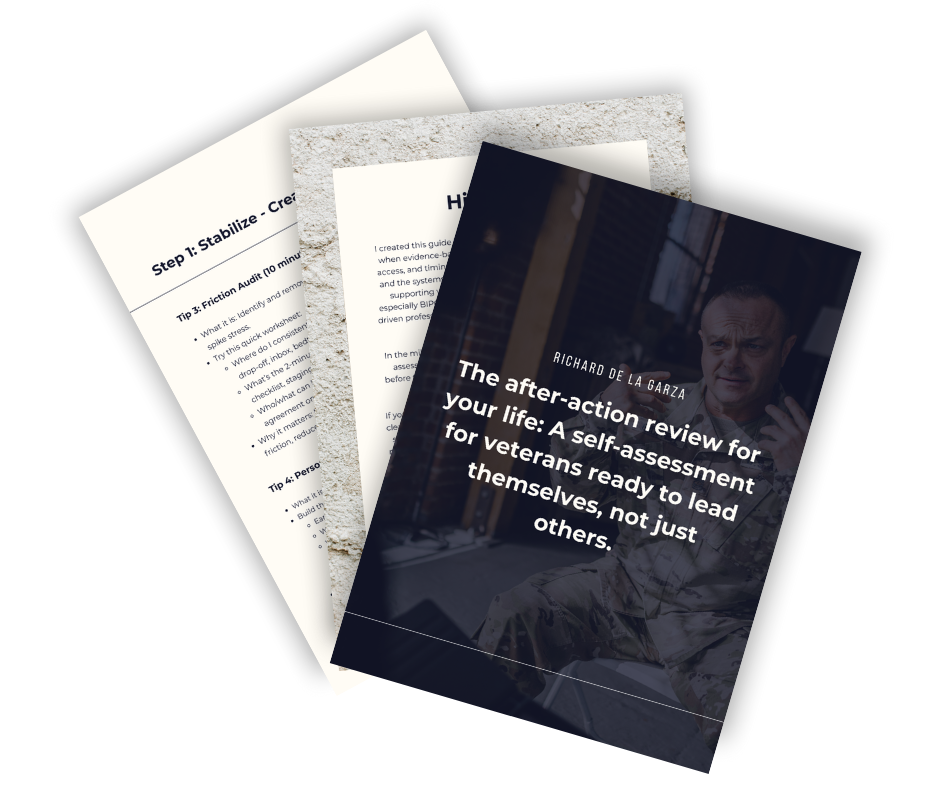
Investment & What’s Included:
I believe in being clear and transparent about pricing, so you know exactly what you’re saying “yes” to.
Complimentary Consultation
START NOWI offer a complimentary 15‑minute phone consultation. During this call, you’ll have the opportunity to share your needs and ask questions.
If you prefer, you can request a consultation via email using the contact form; however, I find that a brief verbal conversation often makes it easier to communicate what you’re looking for.
I invite you to ask about:
- The therapy process in general
- My therapeutic approach
- Payment and logistics
So you can make an informed choice about whether my services are the right fit for you.
- The therapy process in general
Option 1: Individual Session
START NOWInvestment:
- Telehealth (online): $250 per 50‑minute session
- In‑person (only in San Diego, CA): $300 per 50‑minute session
- Students (current full‑time with valid ID): $200 per 50‑minute session
The same 50‑minute session rate applies whether you are an individual, couple, or family.
Includes:
- One 50‑minute 1:1 session (online or in‑person), centered on your current needs and capacity
- Liberation‑rooted, nervous‑system‑informed support (not a one‑size‑fits‑all script)
- A brief post‑session summary with 1–3 grounded practices or reflections to explore
- An email check‑in within a week to support integration and answer clarifying questions
Option 2: Deep Dive Series (6 Sessions over 3 Months)
START NOWInvestment:
$1,500 for 6 sessions
(Payment plans available: 2-3 months, 4+ months
Includes:
- Six 50‑minute 1:1 sessions, scheduled over approximately 3 months
- A shared roadmap we co‑create, grounded in your values, goals, and capacity
- Freire‑inspired reflection + action practices tailored to your real‑life context
- Access to custom resources (handouts, nervous‑system exercises, journaling prompts)
- Brief email support between sessions for questions and check‑ins
- Six 50‑minute 1:1 sessions, scheduled over approximately 3 months
Payments
START NOWI do not accept insurance at this time.
I accept the following forms of payment:
- Major credit cards: Visa, MasterCard, American Express, Discover
- Cash, Apple Pay, Venmo, PayPal, and Zelle
- Checks and debit cards without a credit card feature are not accepted.
- No Surprises Act: You have the right to receive a Good Faith Estimate of what your services may cost.
- Major credit cards: Visa, MasterCard, American Express, Discover
FAQ
What is “military family syndrome”?
It is not a formal diagnosis. The term is sometimes used to describe the cumulative impact that military life can have on families, including frequent moves, separations, high operational demands, and ongoing uncertainty. These factors can influence stress levels, communication, parenting, and overall stability at home.
Will my Chain of Command find out?
No. Counseling is confidential and not shared with your Chain of Command. Your participation remains private, with standard legal exceptions that your therapist will explain.
Is this going to affect my security clearance?
No. Seeking counseling does not harm your security clearance. In many cases, it is viewed as a responsible step toward maintaining stability and functioning.
What if I just want to complain about my spouse?
That is completely okay. Therapy can start with whatever feels most immediate. Over time, the focus shifts from venting to understanding patterns and finding more effective ways to respond.
Do I have to attend in uniform?
No. You can attend in whatever clothing feels comfortable to you. Therapy is a private, civilian space.