Anxiety Therapy | Find Your Ground
Anxiety is often less about fear and more about constant pressure. Many people experience ongoing tension, hypervigilance, and frustration tied to navigating responsibility, uncertainty, or systems and relationships that feel inconsistent or hard to trust. Anxiety can quietly shape your sleep, focus, mood, and sense of control, especially when you feel you have to stay alert just to make sure nothing falls through the cracks.
Support for anxiety here is built for people who are exhausted from carrying responsibility alone and managing demands that were not designed with ease in mind. This work recognizes that anxiety is not a personal flaw. It is a reasonable response to prolonged uncertainty, broken follow through, and environments that demand persistence without offering clarity.
Together, we explore how anxiety shows up in your daily life, how it affects your body and decision making, and what actually helps restore steadiness. Treatment focuses on reducing background stress, building predictable structure, and creating ways for support to show up more reliably so your nervous system does not have to stay on guard.
What is anxiety therapy?
Anxiety refers to the chronic stress, tension, and worry many people experience in connection with responsibility, uncertainty, and systems that are hard to navigate. This can include work demands, family obligations, health concerns, or inconsistent follow through from institutions meant to provide support. Over time, these experiences can keep your nervous system in a constant state of alert, even outside of obvious stressors.
This type of anxiety is important to name because it is often misunderstood as generalized worry or personal overreaction. In reality, it is frequently a rational response to prolonged uncertainty, lack of clarity, and systems that require constant vigilance to function. When left unaddressed, it can affect sleep, focus, mood, relationships, and trust in support overall.
Most common symptoms of anxiety
- Persistent worry about follow through: Constant concern that tasks, deadlines, or decisions will be delayed, mishandled, or forgotten, leading to ongoing mental load.
- Heightened stress and irritability: Anxiety often shows up as tension, frustration, or anger, especially when dealing with unclear processes or repeated demands on your attention.
- Difficulty relaxing or standing down: Even outside stressful tasks, your body may stay on alert, making it hard to rest, slow down, or feel at ease.
- Trouble concentrating and staying organized: Managing multiple responsibilities, deadlines, and expectations can lead to mental fatigue, forgetfulness, or feeling overwhelmed by everyday tasks.
- Avoidance and procrastination: Anxiety can cause you to delay appointments, calls, or tasks because engaging with them feels exhausting or triggering.
- Strain in relationships: The stress of ongoing anxiety can spill into family or work relationships, leading to withdrawal, irritability, or feeling misunderstood.
How do I know if I am dealing with anxiety?
- Do I feel tense or overwhelmed whenever I have to deal with certain responsibilities?: If specific tasks, calls, or follow ups trigger stress that lingers long after they are done, this may point to underlying anxiety.
- Do I worry that things will fall through if I am not constantly on top of them?: Feeling like you have to monitor every step to ensure progress is a common sign that anxiety is tied to reliability and control rather than personal capacity.
- Do I avoid or delay things even when I know I should not?: Procrastination or avoidance can be a response to feeling exhausted or frustrated by past experiences with unclear processes or outcomes.
- Does my anxiety affect my mood, sleep, or relationships?: If stress connected to ongoing responsibilities spills into irritability, poor sleep, or tension with others, it may be impacting more than just logistics.
- Do I feel calmer only after everything is checked, tracked, or confirmed?: Needing constant reassurance or verification can signal a nervous system stuck in vigilance mode.
Ready to get started?
Step 1: Grounded Intake & Shared Mapping
We start with a collaborative intake session where we slow down together, map what’s happening in your body and life, and name the systems, histories, and power dynamics that have shaped how you respond. This isn’t a checkbox assessment, it’s a Freirean dialogue where your story is treated as real knowledge, not a problem to be fixed.
Step 2: Freirean Praxis Sessions (Reflection + Action)
In ongoing 1:1 sessions, we practice praxis: we reflect critically on your patterns, triggers, and environments, and then translate that insight into small, concrete actions that honor your values and your nervous system. You’ll leave each session with 1–3 grounded experiments or practices, no perfectionism, no overwhelm, just doable steps toward more dignity, choice, and ease.
Step 3: Integration, Reclaiming, and Future Alignment
As we work, we regularly pause to reflect on what’s shifting: how you’re feeling in your body, how your relationships and boundaries are changing, and what freedom looks like for you now. Together, we refine your practices, celebrate what’s working, and craft a sustainable way of living and leading that’s aligned with your values, so the transformation isn’t just a session experience, but part of your everyday life.
Hello, I am Richard De La Garza, LCSW.

I work with people who are dealing with anxiety and the ongoing stress of navigating complex responsibilities and systems.
Support for anxiety in my practice is centered on restoring agency. Rather than organizing life around constant monitoring, follow ups, or fear of things falling through, we focus on rebuilding steadiness, clarity, and usable control in real situations. The work is practical, disciplined, and designed to reduce the need for constant vigilance outside the therapy room.
This is a space for people who are ready to stop managing around systems and start living with more calm, confidence, and trust in how their days actually unfold.
What topics can we talk about in therapy for anxiety?
- Reducing constant stress and vigilance: We work on how ongoing pressure keeps your nervous system in alert mode and build ways to lower background stress and mental load.
- Managing uncertainty and lack of follow through: Therapy helps you develop strategies for handling unclear timelines, changing expectations, and broken processes without feeling overwhelmed or consumed.
- Building routines that reduce vigilance: We create simple, predictable structures that lessen the need to constantly check, track, or prepare for worst case scenarios.
- Emotional responses to frustration and exhaustion: We address irritability, anger, anxiety, or shutdown that often develop when dealing with complex demands over long periods.
- Boundaries with people and systems: Therapy supports setting limits around time, energy, and responsibility so anxiety does not take over your entire life.
- Impact on relationships and daily life: We explore how anxiety spills into family, work, and personal life and develop ways to protect those areas from constant pressure.
- Restoring trust and sense of control: The work focuses on rebuilding confidence in your ability to navigate life without carrying everything alone.
Tips and resources for coping with anxiety
- Reduce unnecessary monitoring: Identify which tasks truly require follow up and which do not. Reducing constant checking can lower background stress and mental fatigue.
- Create a clear system for paperwork and communication: Keeping documents, deadlines, and contacts in one place can help you feel more organized and reduce the sense that something will be missed.
- Build routines that restore predictability: Consistent daily habits around sleep, meals, and movement help counter the uncertainty that often fuels anxiety.
- Limit exposure to stress amplifiers: Taking breaks from news, online forums, or conversations that increase frustration can help prevent your stress from escalating.
- Talk with someone who understands: Sharing your experience with a trusted person can reduce isolation and the pressure to explain yourself.

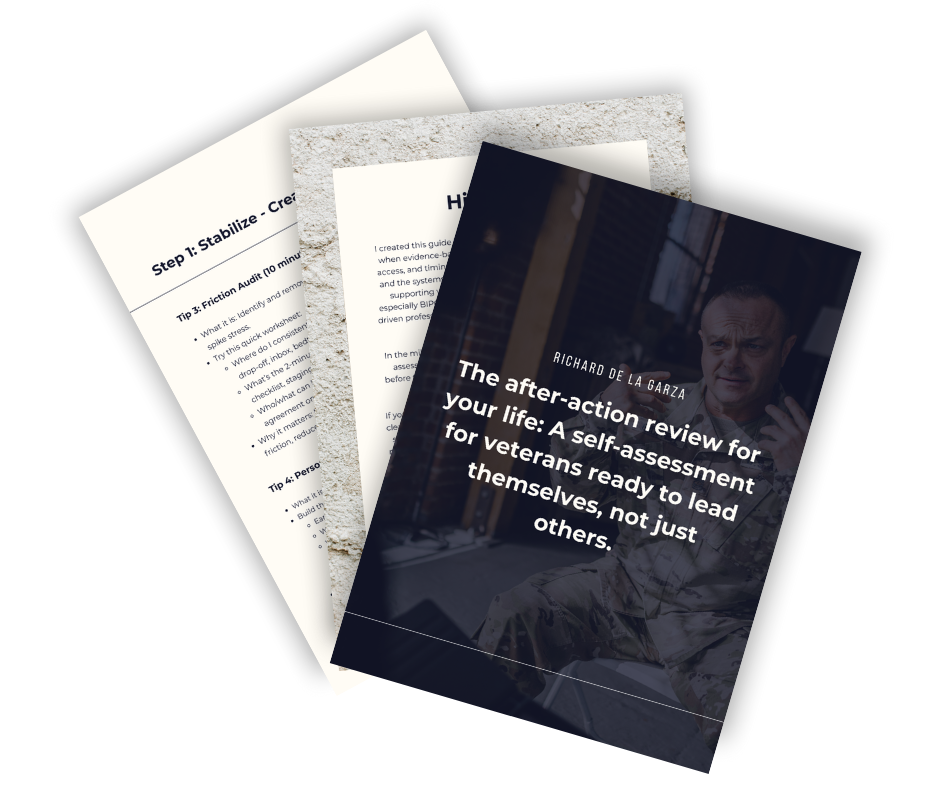
Hi, I’m Dr. Richard De La Garza, a Mexican American–Chicano Licensed Clinical Social Worker
I specialize in liberation-rooted support for veterans, military-connected individuals and families, with a particular commitment to BIPOC and LGBTQ communities.
Investment & What’s Included:
I believe in being clear and transparent about pricing, so you know exactly what you’re saying “yes” to.
Complimentary Consultation
START NOWI offer a complimentary 15‑minute phone consultation. During this call, you’ll have the opportunity to share your needs and ask questions.
If you prefer, you can request a consultation via email using the contact form; however, I find that a brief verbal conversation often makes it easier to communicate what you’re looking for.
I invite you to ask about:
- The therapy process in general
- My therapeutic approach
- Payment and logistics
So you can make an informed choice about whether my services are the right fit for you.
- The therapy process in general
Option 1: Individual Session
START NOWInvestment:
- Telehealth (online): $250 per 50‑minute session
- In‑person (only in San Diego, CA): $300 per 50‑minute session
- Students (current full‑time with valid ID): $200 per 50‑minute session
The same 50‑minute session rate applies whether you are an individual, couple, or family.
Includes:
- One 50‑minute 1:1 session (online or in‑person), centered on your current needs and capacity
- Liberation‑rooted, nervous‑system‑informed support (not a one‑size‑fits‑all script)
- A brief post‑session summary with 1–3 grounded practices or reflections to explore
- An email check‑in within a week to support integration and answer clarifying questions
Option 2: Deep Dive Series (6 Sessions over 3 Months)
START NOWInvestment:
$1,500 for 6 sessions
(Payment plans available: 2-3 months, 4+ months
Includes:
- Six 50‑minute 1:1 sessions, scheduled over approximately 3 months
- A shared roadmap we co‑create, grounded in your values, goals, and capacity
- Freire‑inspired reflection + action practices tailored to your real‑life context
- Access to custom resources (handouts, nervous‑system exercises, journaling prompts)
- Brief email support between sessions for questions and check‑ins
- Six 50‑minute 1:1 sessions, scheduled over approximately 3 months
Payments
START NOWI do not accept insurance at this time.
I accept the following forms of payment:
- Major credit cards: Visa, MasterCard, American Express, Discover
- Cash, Apple Pay, Venmo, PayPal, and Zelle
- Checks and debit cards without a credit card feature are not accepted.
- No Surprises Act: You have the right to receive a Good Faith Estimate of what your services may cost.
- Major credit cards: Visa, MasterCard, American Express, Discover
FAQ
What are effective treatments for anxiety?
Effective treatments include Cognitive Behavioral Therapy, mindfulness based approaches, and structured skills for managing worry and physical tension. The right approach depends on how anxiety shows up for you and what has already been tried.
What's the difference between anxiety and PTSD?
While both can cause hypervigilance, anxiety is usually future oriented worry or restlessness, while PTSD often involves re-experiencing a specific past event through flashbacks, nightmares, or avoidance. Many people experience both, and a thorough evaluation helps clarify which patterns are present.
How long does anxiety treatment take?
It depends on your goals and history. Short term work may last 6 to 12 weeks, while ongoing therapy can continue as needed for more complex or long standing patterns. The focus is on long term continuity of care, not quick fixes.
Can I start therapy for anxiety even if I'm not in crisis?
Yes. You do not need to wait for a crisis to get help. Early intervention for daily stress, irritability, or sleep problems often leads to faster progress and prevents burnout.
Can anxiety treatment address depression or PTSD at the same time?
Absolutely. Anxiety often overlaps with depression or PTSD, and treatment can address co-occurring conditions together using a combination of approaches tailored to your full picture rather than one symptom at a time.